
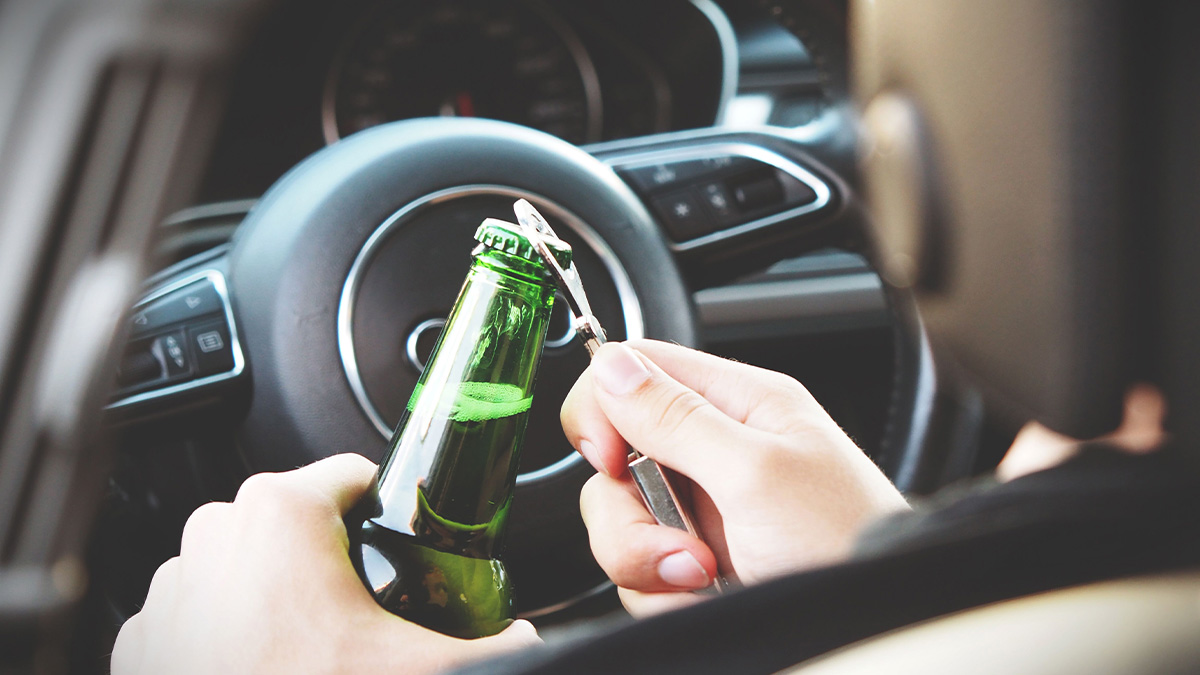

A beer could contain a small amount of alcohol and still qualify under Tennessee’s proposed driving rule. A beer labeled “low alcohol” could contain too much.
The difference comes down to a number on the can: less than 0.5% alcohol by volume. Exactly 0.5% would be outside the cutoff.
That is the detail worth understanding in House Bill 8, a proposal from Rep. Kevin Raper of Cleveland. According to WSMV’s report, Raper filed it November 10 for Tennessee’s 2027–2028 legislative session.
It is a proposal, not permission to change what you open behind the wheel today.
For measures already enacted, our guide to Tennessee laws affecting residents and visitors explains other changes to everyday rules. It’s also one of the rules newcomers to Tennessee learn the hard way.
So the real question is how Tennessee’s open-container law would treat a beer sold as nonalcoholic. Answering it requires looking beyond the product’s name to its alcohol content, the wording of the statute and the date any change becomes effective.
The Small Change That Does the Work
The filed bill would add a definition to Tennessee’s open-container law: “beer” would exclude a beverage containing less than 0.5% alcohol by volume, or ABV.
That is how the proposal would address nonalcoholic beer. It would remove qualifying beverages from the law’s beer category, which matters because the restriction covers both drinking and possessing an open container.
The mechanism is a definition change. The bill does not need to list individual brands or tell stores which shelf to use. Instead, it supplies a numerical test for what counts as beer under this particular restriction.
Despite its broad introductory reference to Tennessee’s alcohol laws, the operative text amends the open-container statute. It does not separately rewrite the state’s general beer statute.
Our read: the practical benefit would be a clearer boundary. Drivers would have an express cutoff in this statute instead of having to work out what the word “beer” covers.
That clarity would have limits. A definition written for one provision should not be treated as an answer to every question involving alcohol, including retail sales or other rules governing a particular location.
If enacted as filed, the change would take effect July 1, 2027, for conduct on or after that date.
Three Labels That Do Not Mean the Same Thing
The shopping problem is that familiar label terms describe different alcohol levels.
Under federal malt-beverage labeling rules, “nonalcoholic” does not mean zero alcohol. “Low alcohol” allows a higher level still.
| What the label says | What the federal rule requires | Comparison with HB 8 |
|---|---|---|
| Nonalcoholic | An adjacent statement that it contains less than 0.5% ABV | Matches the proposed cutoff |
| Alcohol-free | No alcohol | Below the proposed cutoff |
| Low alcohol or reduced alcohol | Less than 2.5% ABV | Wording alone is insufficient |
| Exactly 0.5% ABV | At the bill’s boundary | Outside the proposed exclusion |
Imagine two hypothetical beers on the same shelf. One contains 0.4% ABV. Another contains 1% ABV and is labeled “low alcohol.”
Only the first falls below this bill’s cutoff. The second could meet the federal condition for a low-alcohol label while still containing too much alcohol for the proposed exclusion.
For someone choosing a drink, that is a useful distinction: a relative description such as “reduced alcohol” does not tell you whether the product meets an absolute legal limit.
The federal rules also reserve “alcohol-free” for malt beverages containing no alcohol. A 0.0% ABV claim must be accompanied by that designation and the product must contain none.
These labeling comparisons apply to malt beverages. They should not be automatically extended to every wine alternative, mocktail or spirits substitute using similar language.
What the Percentage Measures
ABV describes the proportion of a drink’s volume that is alcohol. It is not the number of ounces in the container.
For a simple hypothetical comparison, consider two 12-ounce drinks:
- At 0.4% ABV, the drink contains 0.048 fluid ounces of alcohol.
- At 5% ABV, the drink contains 0.6 fluid ounces of alcohol.
Those figures come from multiplying the container size by the alcohol percentage expressed as a decimal. The first contains 8% as much alcohol as the second, despite having the same total volume.
The calculation helps explain how a beverage can contain some alcohol while having much less than another beer. It doesn’t mean any amount is safe to drink before driving.
For this bill, the legal test would remain the percentage. A smaller serving of a hypothetical 1% beer would still be 1% ABV. Its container size would not bring its alcohol concentration below 0.5%.
An Open Container Does Not Require a Sip
The Tennessee Department of Safety and Homeland Security’s guidance says drivers may not consume or possess an open container of an alcoholic beverage or beer while operating a motor vehicle.
The published statutory text explains what those words cover. Its definition of an open container includes a container whose contents can immediately be consumed or whose seal has been broken.
That makes the condition of the container important. For a beverage covered by the law, putting the cap back on after opening it doesn’t undo a broken seal.
Location matters, too. The possession definition distinguishes a container held by a passenger or stored in a closed glove compartment, trunk or other nonpassenger area from one attributed to the driver.
Consider a hypothetical opened bottle of regular beer left in the cup holder while a driver travels alone. Saying “I was taking it home” would not, by itself, resolve the possession issue.
The practical lesson is to consider the beverage, the container and where it is located together. Looking only at whether the driver drank from it leaves out part of the rule.
Parking Does Not Automatically Put You Outside the Rule
The same statute treats a vehicle as operating when its engine is operating, whether or not the vehicle is moving.
Imagine waiting in a parking space with the engine running. Selecting Park doesn’t, by itself, remove the driver from this definition.
For readers who picture “behind the wheel” as traveling down the interstate, that stationary-car detail changes how the current restriction should be understood.
These provisions explain the existing restriction. They do not settle how every product marketed as nonalcoholic beer is currently classified.
Passengers Need to Check a Different Question
The driver-focused language should not be read as a statewide promise that passengers can open any alcoholic drink.
The statute expressly allows municipalities and counties to prohibit passengers from consuming or possessing alcoholic beverages or beer in open containers while the vehicle is operating.
That means a passenger question can involve a local ordinance or county resolution as well as the state provision.
For a group traveling between communities, the useful check is the rule where the vehicle will be operating. The fact that a passenger holds a container answers only one part of the driver-possession definition; it doesn’t establish that the passenger’s conduct is lawful.
HB 8’s proposed definition change should therefore be read within its stated scope. It would not, by itself, rewrite the wording of every local ordinance.
What to Check When the Bill Makes News Again
A bill expressly excluding certain drinks doesn’t prove that every one of those drinks was previously prohibited. The filed text describes a proposed change; it is not a court ruling about all products already on store shelves.
Future headlines may also describe different stages of the process. Filing introduces a proposal. Committee action or passage in one chamber is progress, but neither alone establishes an enacted law.
When another update appears, look for the text being discussed, its legislative status and its effective-date provision. An amendment could change the cutoff or the start date, making an earlier summary outdated.
As with Tennessee’s January registration change, the date matters because an announced legal change can precede the day drivers need to act on it.
For HB 8 as filed, July 1, 2027, is conditional on enactment in that form. The clearest useful update would identify what became law, which beverages it covers and when that language begins applying.
Until then, the number on the can tells you about the drink. It doesn’t tell you whether Tennessee has changed the law.
More from Real Tennessee Life…

Tennessee Returned a Record 169,303 Unclaimed Property Claims. So Why Did the Checks Get Smaller?

Three Liver Transplants in 12 Hours: How Vanderbilt’s Team Did It and Why Nashville’s Transplant Center Is the Nation’s Busiest